Cracking good classics
From BlackWhite magazine - issue 11, accent
The endless enchantment of eggshell blues continues to captivate designers.
It’s no secret that New Zealanders and Australians love decorating with neutrals. For decades, a range of Resene whites and creams have consistently reigned the Resene Top 20 colours based on sales. But among Resene’s more chromatic colours, there’s one hue that has captivated architects, designers and their clients like no other: Resene Duck Egg Blue.

There are few colours that carry the enduring appeal and quiet sophistication of Resene Duck Egg Blue and its variants. This pale, soft greenish blue with a grey undertone evokes tranquility and gentle refinement that transcends passing trends. Beyond aesthetics, the emotional resonance of duck egg blue cannot be understated. Psychologically, soft blue-green tones are known to reduce stress and promote calm, providing a quiet refuge and a sense of airiness.
The origins of Resene Duck Egg Blue are, as the name suggests, grounded in nature. The colour mimics the luminous shells of eggs laid by certain duck breeds. Another hue named for eggshells, Resene Robin Egg Blue holds much the same appeal. Though this colour features a distinctly greener tone, it is equally alluring and offers equivalent benefits and flexibility.
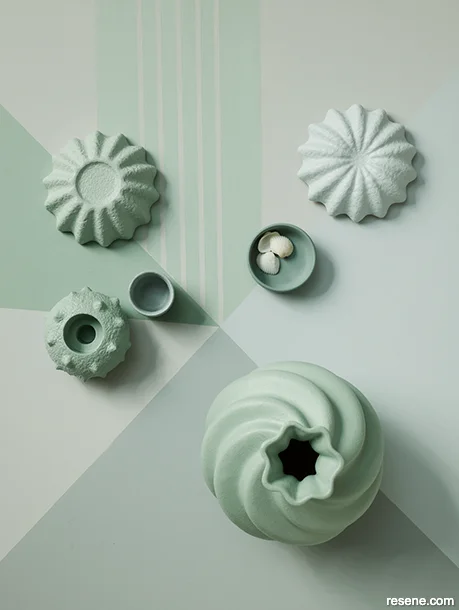
Background colours in (clockwise from top left) Resene Half Duck Egg Blue with stripes in Resene Half Robin Egg Blue, Resene Duck Egg Blue, Resene Double Duck Egg Blue, Resene Quarter Duck Egg Blue and Resene Robin Egg Blue, objects painted in (clockwise from top left) Resene Half Robin Egg Blue, Resene Robin Egg Blue, Resene Half Duck Egg Blue, Resene Robin Egg Blue and Resene Half Robin Egg Blue. Project by Amber Armitage, image by Melanie Jenkins.

Wall painted in Resene Duck Egg Blue, floor in Resene White Pointer, shelves in Resene Inside Back, shelf décor in (from top to bottom, left to right) Resene Inside Back, Resene White Pointer, Resene Double Duck Egg Blue, Resene Neutral Bay, Resene Breathless and Resene Half Duck Egg Blue, floor vases in Resene Alabaster and Resene Arrowtown and stool and sconce in Resene Scoria. Project by Amber Armitage, image by Melanie Jenkins.
Historically, duck egg blue and robin egg blue have no known singular point of invention but comparable combinations of blue and green minerals such as copper-based azurite and malachite can be traced back to ancient Egyptian and Chinese civilisations who used similar tones in pottery, murals and clothing dyes. It wasn’t until the late 18th and early 19th centuries that these eggshell blues began to gain real traction in interior decoration. As Georgian and Regency styles evolved, soft blues and greens were seen as ideal for spaces meant to exude poise and elegance, such as drawing rooms and parlours. In the Victorian period, with the introduction of mass-produced paints and the influence of botanical illustration and natural history, eggshell blues found their way into wallpapers and furnishings and were appreciated for their delicate balance between colour and neutrality.

Stairwell walls in Resene Paris White with ceiling and doorframe in Resene Half Bianca.
Project by Kurio. Build by Refresh Renovations. Image by Helen Bankers.

Tongue-and-groove panelling painted in Resene Morning Haze and floor finished in Resene Colorwood Breathe Easy and clearcoated in Resene Qristal ClearFloor.
Bed and dresser from Mocka, bedlinen from A&C Homestore,lamp and chair from Slow Store, cushion and chequered pot, tray, book and toy from Kmart. Project by Amber Armitage, image by Wendy Fenwick.
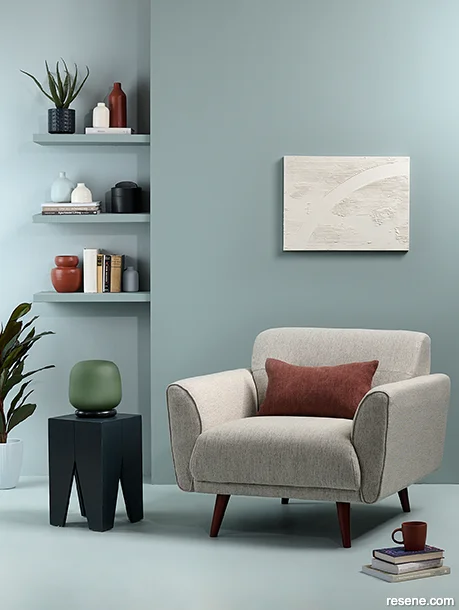
Main wall and shelves painted in Resene Inside Back, recessed wall (left) in Resene Hermitage, floor in Resene Half Duck Egg Blue.
Side table in Resene Cinder, large plant pot (on floor) in Resene Duck Egg Blue, décor on shelf in Resene Half Duck Egg Blue, Resene Duck Egg Blue, Resene Innocence, Resene Mocha, Resene Cinder and Resene Blanc and artwork in Resene Blanc. Project by Laura Lynn Johnston, image by Bryce Carleton.
The journey of eggshell blues from Europe to New Zealand and Australia is as much about aesthetic sensibility as it is about climate. British settlers brought with them a tradition of soft, nature-inspired palettes. When faced with the brighter, sunlit environments of the Southern Hemisphere, these gentle tones took on a new life and popularity. Thanks to their cool undertones, Resene Duck Egg Blue and Resene Robin Egg Blue have proven to be ideal foils for the often harsh light of our local landscapes – offering a means of softening spaces with a sense of serenity that complements both traditional villas and casual beach houses.

Today, eggshell blues remain favourites in contemporary interior design. Their versatility is unmatched, and they pair seamlessly with whites, creams and greys while also working beautifully with natural wood, brass and rattan. These colours continue to be a staple in coastal and Hamptons-style homes, where they reflect the sea and sky in a way that feels both modern and timeless. Thanks to their pale vibrancy, these hues are also beloved for bringing a breath of fresh air to commercial offices, healthcare facilities and schools.
More than a trend, eggshell tones like Resene Duck Egg Blue, Resene Robin Egg Blue, Resene Eau De Nil, Resene Unwind and Resene Opal connect past to present and heritage to modernity. Whether used tonally or in subtle contrast to other hues, eggshell blues are a versatile cornerstone in a designer’s toolkit which can adapt to a range of settings and styles while retaining their signature air of serenity and effortless sophistication.
Colours mentioned in this article













Resene Breathe Easy


















Product mentioned in this article